
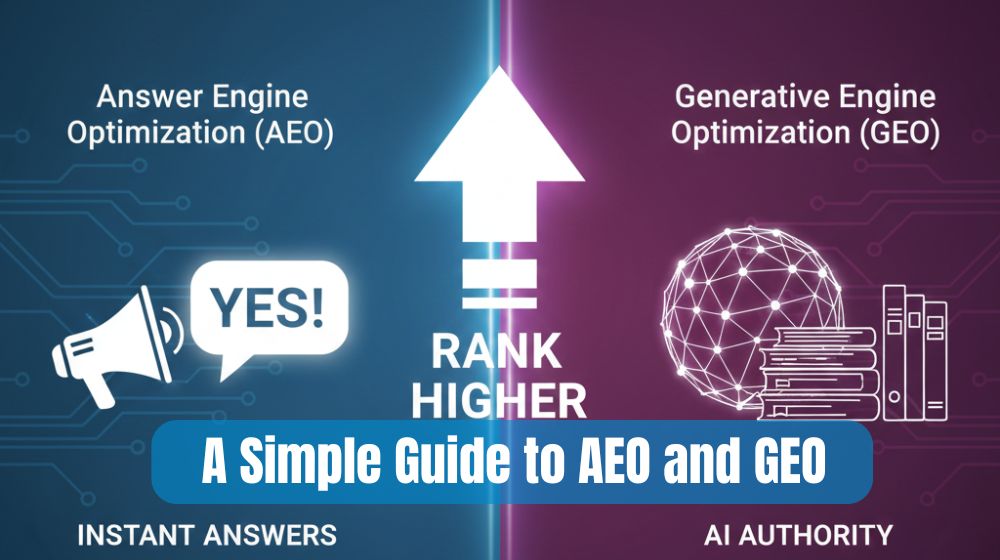
If you’ve noticed that your usual Google searches look a bit different lately, you aren’t alone. We are moving away from the era of “click a link and hope for the best” and into an era where AI simply tells us what we need to know. For anyone running a website or writing a blog, this is a huge shift. To stay visible, you need to understand two big concepts: what is answer engine optimisation and what is generative engine optimisation.
In this guide, we’re going to break down how to handle this shift using practical answer engine optimization strategies and generative engine optimization strategies. It sounds technical, but it’s actually about being more helpful to your readers and making sure the “robots” can actually find your hard work.
The Basics: What is Answer Engine Optimisation?
Let’s start with the basics: what is answer engine optimisation? Essentially, AEO is about being the “instant answer.” Think about when you ask a smart speaker for the weather or a recipe. That device isn’t reading you a whole website; it’s giving you a specific snippet of information.
When people ask, “what is answer engine optimisation,” they are looking for ways to make their content the primary response for these quick queries. If your content is buried in a long, rambling paragraph, an AI assistant won’t find it. That’s why understanding what is answer engine optimisation is the first step to winning the “zero-click” search battle.
In simple terms, what is answer engine optimisation? It’s the art of being concise. If you can explain a complex topic in two sentences, you are already winning at what is answer engine optimisation. Every time someone asks Google a question and gets a direct box at the top, they are seeing the results of what is answer engine optimisation.
Moving Further: What is Generative Engine Optimisation?
Now, let’s talk about the next level: what is generative engine optimisation? While AEO is about quick answers, GEO is about being part of a larger conversation. Tools like ChatGPT or Google Gemini don’t just give one-sentence answers; they “generate” full explanations.
So, what is generative engine optimisation? It is the process of making sure your brand or website is the source that these AI models use to build their responses. When we look at what is generative engine optimisation, we are focusing on how to get an AI to trust our information enough to cite it.
If you aren’t sure what is generative engine optimisation in practice, think of it as digital PR for AI. By understanding what is generative engine optimisation, you ensure that when an AI summarizes a topic, your website is the one it points to as the expert. Learning what is generative engine optimisation is essential because more people are using AI chats to research products and services instead of scrolling through pages of links.
Practical Answer Engine Optimization Strategies
To get your content picked up for quick answers, you need a specific game plan. These answer engine optimization strategies are all about structure and clarity.
One of the best answer engine optimization strategies is to literally write out the questions your customers ask. If you run a plumbing business, don’t just write about “Pipe Maintenance.” Use a heading like “How do I fix a leaky faucet?” and follow it with a clear, step-by-step list. This is one of those answer engine optimization strategies that works because it mimics how people actually talk to their devices.
Here are a few more answer engine optimization strategies to keep in mind:
- Use Bullet Points: AI loves lists. This is one of the simplest answer engine optimization strategies.
- Keep it Brief: Try to answer the main question in under 50 words. Many successful answer engine optimization strategies focus on this “snippet-sized” content.
- Q&A Sections: Having a dedicated “Common Questions” section on every page is a staple of good answer engine optimization strategies.
If you ignore these answer engine optimization strategies, you might have great content that nobody ever sees because it’s too hard for an “answer engine” to digest quickly.
The Technical Side: GEO SEO Checklist
You can have the best content in the world, but if your Technical SEO part is messy, the AI might skip over you. When people ask what is generative engine optimisation, they often forget the technical foundation. To really succeed with generative engine optimization strategies, you need to make your site “AI-readable.”
Here is the technical checklist for your generative engine optimization strategies:
1. Structured Data (Schema Markup)
This is like giving the AI a map of your page. You should use FAQ Schema for your questions and Article Schema for your blogs. This is one of the most important technical generative engine optimization strategies because it tells the AI exactly who wrote the piece and what the main points are.
2. Robots.txt and AI Crawlers
Make sure you aren’t accidentally blocking the bots! Check your robots.txt file to ensure “GPTBot,” “Google-Extended,” and “PerplexityBot” are allowed to visit your site. You can’t benefit from generative engine optimization strategies if the AI isn’t allowed to read your pages.
3. Server-Side Rendering (SSR)
If your website relies heavily on JavaScript to load, AI bots might have a hard time seeing your content. One of the best technical generative engine optimization strategies is using Server-Side Rendering so that the text is “ready to read” the second a bot lands on the page.
4. Site Speed and Core Web Vitals
AI engines prioritize fast sites. If your page takes 10 seconds to load or your other core web vitals are not proper, it won’t be used as a source. Keeping your site lightning-fast is a foundational part of both answer engine optimization strategies and generative engine optimization strategies.
Essential Generative Engine Optimization Strategies (Content Wise)
If you want to be the “source of truth” for AI models, your generative engine optimization strategies need to be a bit deeper. AI models look for authority and proof.
One of the most effective generative engine optimization strategies is to include original data or unique insights. If you can provide a statistic that no one else has, AI models are much more likely to cite you. This makes “original research” one of the top-tier generative engine optimization strategies.
Other generative engine optimization strategies include:
- Author Authority: Use real bios. AI prioritizes trusted human voices, so this is a key part of generative engine optimization strategies.
- Clear Citations: Link to other reputable sites. It shows the AI you’ve done your homework, which is a big part of smart generative engine optimization strategies.
- Topic Hubs: Don’t just write one post. Write five posts about one topic and link them together. This is a classic example of generative engine optimization strategies that build “topical authority.”
When you combine these generative engine optimization strategies, you aren’t just ranking for a keyword; you are building a reputation that AI models will recognize and reward.
How AEO and GEO Work Together
You might be wondering if you have to choose between answer engine optimization strategies and generative engine optimization strategies. The truth is, you need both.
Imagine a user asks, “What is the best type of running shoe?”
- Your answer engine optimization strategies help you provide a quick list of the top three shoes for a featured snippet.
- Your generative engine optimization strategies help you get cited when the user asks the AI to “Explain why carbon-plated shoes are better for marathons.”
Without strong answer engine optimization strategies, you miss the quick “top-of-page” wins. Without strong generative engine optimization strategies, you miss out on being the deep-dive authority that people trust.
Simple Steps to Start Today
You don’t need to be a coding genius to start using answer engine optimization strategies or generative engine optimization strategies. Start small.
- Check your FAQs: Do you have an FAQ page? If not, build one. This is the foundation of both answer engine optimization strategies and generative engine optimization strategies.
- Use “What is” and “How to” headings: This helps with what is answer engine optimisation by giving the AI a clear target.
- Update your facts: AI models cross-check information. Keeping your facts accurate is a basic but vital part of your generative engine optimization strategies.
- Simplify your language: The easier your text is to read, the better your answer engine optimization strategies will perform.
Conclusion
The world of search is changing, but it doesn’t have to be overwhelming. Once you understand what is answer engine optimisation and what is generative engine optimisation, you have the roadmap you need to succeed.
By focusing on clear, direct responses through answer engine optimization strategies, you’ll capture the attention of people on the go. By building deep, authoritative content through generative engine optimization strategies, you’ll ensure that AI models keep recommending you as the expert.
Remember, the goal of what is answer engine optimisation and what is generative engine optimisation is ultimately to serve the person searching. If you focus on being the most helpful, accurate, and easy-to-read source in your niche, your rankings will follow. Keep experimenting with new answer engine optimization strategies and stay updated on the latest generative engine optimization strategies—because the AI world moves fast!
If you are looking for Complete technical part for you article page than Our Tool and guidance will help you to properly work on all your technical part of your page.