
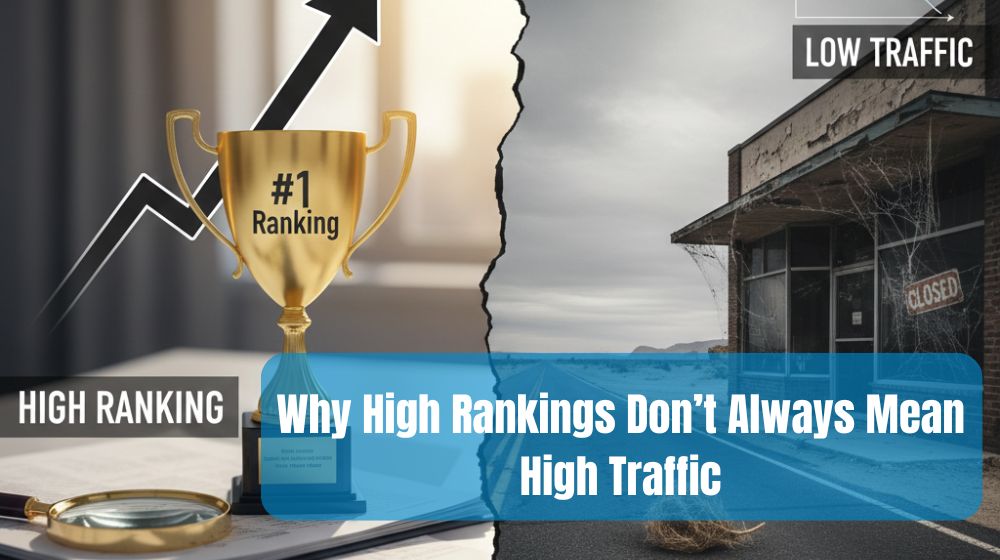
For years, the ultimate goal of every website owner, marketer, and business has been the same: Rank #1 on Google.
We are taught that the top spot is the holy grail. We believe that if we can just get our website to the top of the first page, the floodgates will open, and traffic will pour in.
But what happens when you finally reach that summit, look at your analytics, and see… nothing?
It is a frustrating scenario that happens more often than you might think. You check your rank tracker, and it says you are sitting pretty at position #2 or #3. But when you check Google Analytics, your traffic is flat.
Here is the hard truth: Ranking is just a visibility metric. Traffic is a performance metric.
High rankings do not automatically guarantee high traffic. If you are ranking well but not getting clicks, it’s not bad luck—it’s a specific technical or psychological issue with how your result appears in the search engine results page (SERP).
In this guide, we will break down exactly why this happens, look at the “silent killers” of organic traffic, and provide a step-by-step plan to turn those rankings into actual visitors.
1. The “Ghost Town” Keyword (Low Search Volume)
The most common reason for high ranking but low traffic is surprisingly simple: Nobody is searching for that specific phrase.
It feels great to rank #1 for a specific keyword. But if that keyword has a monthly search volume of 10, ranking #1 means you are capturing 100% of almost nothing.
The Long-Tail Trap
Many SEO strategies focus on “long-tail keywords” (phrases that are longer and more specific). While these are easier to rank for, they often come with very low volume.
- Example: You might rank #1 for “Best blue leather running shoes for men under $50 in 2024.”
- The Problem: While you are the king of that specific hill, there might only be five people in the whole world searching for exactly that string of words this month.
How to Fix It:
- Re-evaluate Keyword Research: Use tools like Google Keyword Planner, SEMrush, or Ahrefs to check the “Search Volume” column. Ensure you aren’t targeting keywords that are too obscure.
- Target “Parent” Topics: Instead of creating a separate page for every tiny variation, create a comprehensive page that targets a broader topic (e.g., “Affordable Men’s Running Shoes”) which includes those smaller long-tail keywords as sections.
- Don’t Ignore Low Volume (If the Intent is High): A caveat here—if you sell a high-ticket item (like enterprise software), 10 searches a month might be fine if 5 of them convert. But for general traffic growth, you need volume.
2. The Click-Through Crisis (Low CTR)
Imagine you own a shop on the busiest street in the city. Thousands of people walk past your window every day (Impressions), but nobody opens the door (Clicks).
Why? Because your window display is boring, dark, or confusing.
In SEO, this is your Click-Through Rate (CTR). You might rank #2, but if the website at #3 has a more catchy Meta Tags, users will skip you and click them instead.
Why Users Skip Your Result:
- Boring Meta Titles: A title like “Home Page – Brand Name” tells the user nothing. Compare that to “10 Tips to Save Money Fast (2024 Guide).”
- Weak Meta Descriptions: If your description is cut off (truncated) or just lists keywords, it won’t entice a click. It needs to be a mini-advertisement for your page.
- Lack of “Hooks”: Human brains are wired to look for numbers, brackets, and emotional words.
- Bad: “How to bake a cake.”
- Good: “How to Bake a Perfect Cake in 30 Minutes (Beginner Friendly).”
The “Skyscraper” Competitor
Sometimes, you aren’t doing anything wrong, but your competitor is just doing it better. If the result below you uses “Rich Snippets” (like star ratings, pricing, or images directly in the search result), their listing will look larger and more trustworthy than yours.
3. The “Zero-Click” Phenomenon (SERP Features)
This is the biggest shift in modern SEO. Google is no longer just a library that points you to books; Google is trying to become the librarian who reads the book for you and gives you the answer directly.
This leads to Zero-Click Searches. The user searches, sees the answer on Google, and closes the tab without ever visiting a website.
Who is Stealing Your Clicks?
- Featured Snippets: That box at the top of the search results that gives a direct definition or list. If you rank #2, but the #1 spot gets the snippet, they might get the click—or the user gets the info and leaves.
- People Also Ask (PAA): These expandable questions push organic results further down the page. Users can often find their answer by expanding a PAA box.
- AI Overviews (SGE): Google’s new AI-generated answers appear at the very top, summarizing complex topics. If the AI answers the user perfectly, why would they scroll down to click your link?
- Knowledge Panels: For businesses or famous entities, the information box on the right side of the screen often provides the address, phone number, and hours. The user gets what they need without visiting your site.
Can You Fight This?
You cannot stop Google from doing this, but you can adapt. You need to target keywords that require depth—topics where a simple 2-sentence summary isn’t enough, forcing the user to click for the full story.
4. The Intent Mismatch (Wrong Content Type)
Search Intent is the “why” behind a search. When someone types a keyword, what do they want?
- Do they want to buy? (Transactional)
- Do they want to learn? (Informational)
- Do they want to find a specific website? (Navigational)
If your page content doesn’t match the intent, you might rank (temporarily), but you won’t get satisfied traffic.
The Mismatch Scenario
Imagine you rank #1 for “Best CRM Software.”
- User Intent: The user likely wants a listicle comparing 10 different software options with pros and cons.
- Your Content: Your page is a product page selling only your specific CRM software.
Even if you rank, users will see your title, realize it’s just a sales page, and scroll past to find a comparison guide (like G2 or Capterra). Or, they will click, realize it’s not a comparison, and hit the “Back” button immediately.
How to Fix It:
Before writing content, Google your target keyword.
- Are the top results blog posts? Then write a blog post.
- Are they product pages? Then create a product page.
- Are they video tutorials? Then make a video. Align with what Google is already rewarding.
5. Engagement Issues (Bounce Rate & Dwell Time)
Let’s say you successfully get the user to click. You rank high, and your title was catchy. The user lands on your site.
Then they leave 5 seconds later.
From an analytics perspective, this counts as a visit. But from an SEO perspective, this is a disaster. This is called “Pogo-sticking”—when a user clicks a result, hates it, bounces back to Google, and clicks a different result.
Why Do Users Bounce?
- Slow Loading Speed: If your site takes more than 3 seconds to load, mobile users are gone.
- Wall of Text: If users see a massive block of text with no headings, images, or bullet points, they will feel overwhelmed.
- Clickbait: If your title promised “Free Templates” but the page asks for a credit card immediately, the user feels tricked.
- Poor Mobile Design: If pop-ups cover the screen or the text is too small on a phone, the user experience (UX) is ruined.
If Google sees that everyone who clicks your link comes right back, they will eventually drop your ranking because your page isn’t solving the user’s problem.
6. How to Diagnose and Fix Your “High Rank, Low Traffic” Problem
So, you have identified that you have a problem. How do you actually fix it? Here is a checklist to audit your site.
Step 1: Check Your “Real” CTR
Go to Google Search Console (GSC). Look at the “Performance” report.
- Filter by query.
- Look for keywords where you rank in the top 3 but have a CTR below 3-5%.
- These are your “opportunity keywords.” You are visible, but ignored. Rewrite the Meta Titles and Descriptions for these specific pages.
Step 2: Audit the SERP Layout
Search for your keyword in Incognito mode.
- Are there 4 ads at the top?
- Is there a massive AI answer?
- Is there a map pack? If the organic results are pushed way down “below the fold” (meaning you have to scroll to see them), you might need to target a different, less cluttered keyword, or invest in Google Ads to appear at the top.
Step 3: Add Schema Markup
Schema is code you put on your website to help Google understand your content. It helps you get those “Rich Results” mentioned earlier.
- FAQ Schema: Can display questions and answers right in the search results.
- Review Schema: Adds yellow stars next to your product.
- Product Schema: Shows price and availability. These visual elements make your result pop off the screen, increasing clicks even if your ranking position stays the same.
Step 4: Improve Content “Skimmability”
Modern web users do not read; they scan. To keep them on the page (and improve Dwell Time):
- Use short paragraphs (2-3 sentences max).
- Use bullet points (like this list!).
- Use bold text to highlight key takeaways.
- Add images or videos every 300 words.
Step 5: Internal Linking
Sometimes your high-ranking page is a “dead end.” Use that traffic! Add links in the first paragraph pointing to other relevant articles or product pages on your site. This keeps the user moving through your ecosystem rather than bouncing back to Google.
Conclusion: The Mindset Shift
It is time to stop obsessing over vanity metrics.
Ranking #1 is an ego boost. Traffic and conversions are business assets. You cannot pay your bills with “rankings.”
SEO today is not just about beating the algorithm; it is about winning the user.
It is no longer enough to just include keywords and build backlinks. You must earn the click with compelling copy, satisfy the user with excellent content, and keep them engaged with a great user experience.
If your site ranks well but traffic is low, don’t celebrate the rank. Put on your detective hat. Diagnose the SERP, analyze the user intent, and optimize for the click.
Final Takeaway:
- Ranking = Visibility (The opportunity to be seen).
- Traffic = Persuasion (The result of a good title and intent match).
- Revenue = Satisfaction (The result of great content and UX).
Don’t just strive to be on Page 1. Strive to be the result that everyone wants to click.
Check out Our Latest Tool That will help you to Get maximum CTR Seo Analyzer
